
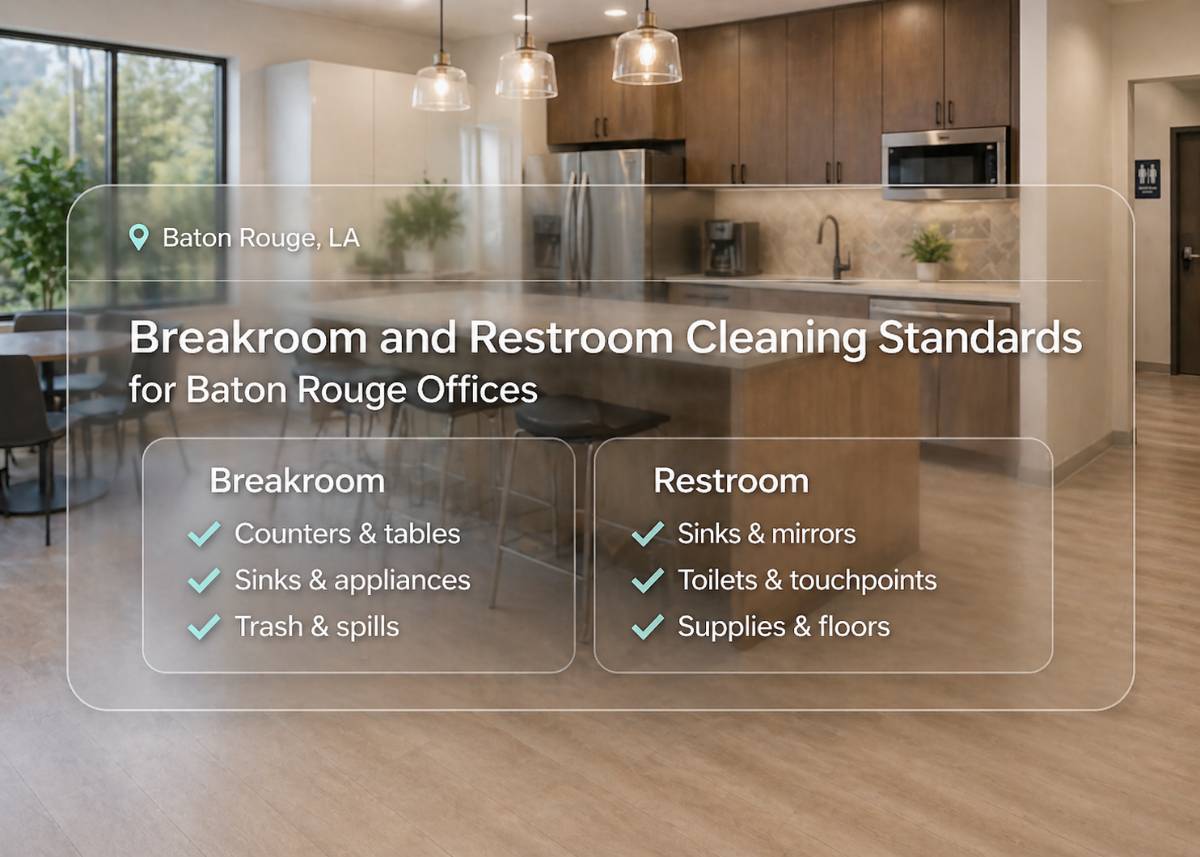
Office restroom and breakroom cleaning in Baton Rouge should follow clear, repeatable standards. At a minimum, that means cleaning and sanitizing fixtures, counters, sinks, toilets, touchpoints, trash areas, and floors, while also setting expectations for appearance, odor control, and supply readiness. Without standards, shared spaces are where offices most often start to feel neglected.
That is why breakrooms and restrooms deserve more than vague “general cleaning.” They need a defined checklist and a realistic service rhythm.
Key Takeaways
- Restrooms and breakrooms are the two shared office spaces where missed details are noticed fastest.
- Good standards cover appearance, sanitation, touchpoints, trash, and floors.
- A written restroom cleaning checklist and breakroom cleaning checklist reduce inconsistency.
- Higher-traffic offices usually need more frequent touchpoint, trash, and floor attention.
- Clear expectations help office managers compare vendors more effectively.
- The best office cleaning plans match the actual pace of the workplace, not a one-size-fits-all schedule.
Why Breakroom and Restroom Standards Matter
In most offices, restrooms and breakrooms carry more daily wear than nearly any other shared space.
That makes them important for two reasons.
First, they affect how clean the workplace feels overall. Employees and visitors notice dirty sinks, full trash bins, sticky counters, smudged fixtures, and unpleasant restroom conditions quickly.
Second, these spaces include the surfaces people touch most often. Door handles, faucets, dispensers, microwave handles, refrigerator pulls, chair backs, and table edges all get repeated use throughout the day.
When standards are unclear, the result is inconsistency. One visit may look thorough, while the next misses obvious problem areas. Strong office cleaning plans avoid that by defining what gets cleaned, how often, and what “done” should look like.
Office Restroom and Breakroom Cleaning Baton Rouge: What Good Standards Look Like
A practical standard should be specific enough that a manager can walk into the space and tell whether it was completed properly.
In most offices, that means four things:
- Visible cleanliness: Counters, sinks, fixtures, mirrors, tables, and floors look clean rather than rushed over.
- Touchpoint sanitation: Frequently handled surfaces are addressed consistently, not occasionally.
- Waste control: Trash is removed before overflow and liners are reset properly.
- Shared-space readiness: The room looks usable, orderly, and ready for the next person.
For restrooms, that also includes toilets, urinals, partitions, dispensers, and odor control.
For breakrooms, it usually includes counters, sink areas, appliance exteriors, table surfaces, and spill-prone floor zones.
A good commercial cleaning Baton Rouge plan does not rely on guesswork. It defines the scope clearly so routine cleaning is measurable.
Restroom Cleaning Checklist for Offices
A restroom cleaning checklist should focus on both sanitation and presentation.
Here is a practical standard for office restrooms:
- Toilets and urinals: Cleaned and sanitized, with visible residue and splash areas addressed.
- Sinks and faucets: Basin, faucet, and surrounding counter cleaned and dried down as needed.
- Mirrors: Smudges and splash marks removed.
- Counters and ledges: Wiped and sanitized.
- Dispensers: Exterior cleaned; supply status checked if restocking is part of service.
- Door handles and push plates: Disinfected as part of touchpoint cleaning.
- Stall locks and partitions: Wiped where visibly marked or frequently touched.
- Trash receptacles: Emptied and relined.
- Floors: Spot issues addressed and full floor cleaning completed based on schedule.
- Odor sources: Waste and visible buildup addressed promptly.
This kind of restroom cleaning checklist helps prevent the most common complaints: dirty fixtures, missed handles, trash overflow, and floors that still look used immediately after service.
Breakroom Cleaning Checklist for Offices
Breakrooms need a different standard because the mess is usually food-related, high-touch, and fast-moving.
A practical breakroom cleaning checklist includes:
- Countertops: Wiped and sanitized.
- Sink and faucet: Cleaned, including surrounding splash areas.
- Tables and chair touchpoints: Wiped and left ready for use.
- Appliance exteriors: Microwave, refrigerator, coffee station, and other frequently touched surfaces wiped down.
- Cabinet and handle touchpoints: Cleaned where commonly handled.
- Trash and recycling areas: Emptied, liners reset, exterior wiped as needed.
- Floor around food-prep and trash zones: Spot-treated and cleaned to remove crumbs, drips, and visible debris.
- Shared items area: Surfaces around coffee makers, water stations, and supply zones cleaned.
A breakroom does not have to look untouched to meet a good standard. It should look reset, sanitary, and ready for normal use again.
Suggested Cleaning Frequency by Area
Cleaning frequency should reflect traffic, not just square footage.
Here is a practical planning guide for many offices:
- Restroom fixture cleaning: Daily or each service visit in lower-traffic offices; daily and sometimes more than once per day in higher-traffic offices.
- Restroom touchpoints: Daily in lower-traffic offices; multiple times per day if traffic is heavy.
- Restroom trash: Daily or as needed in lower-traffic offices; daily or more often in higher-traffic offices.
- Breakroom counters and sink: Daily or each service visit in lower-traffic offices; daily, often with extra touchups, in higher-traffic offices.
- Breakroom appliance exteriors: Several times per week or each service visit in lower-traffic offices; daily in higher-traffic offices.
- Breakroom trash: Daily or as needed in lower-traffic offices; daily or more often in higher-traffic offices.
- Shared-space floors: Daily or each service visit in lower-traffic offices; daily with extra spot attention in higher-traffic offices.
- Deep-detail tasks: Scheduled periodically in lower-traffic offices and more frequently in higher-traffic offices.
This is not a universal rule for every office. A small private office will not need the same rhythm as a busier workplace with many employees and steady visitor traffic.
What Standards Prevent Missed Areas
Missed areas usually happen for one of three reasons: the scope is vague, the space is changing too fast, or the checklist is not specific enough.
The best prevention methods are simple.
1. Use zone-based checklists
Break the job into restroom zones and breakroom zones instead of broad instructions like “clean kitchen” or “clean bathroom.” Specific zones are easier to inspect and harder to skip.
2. Treat touchpoints as their own category
Touchpoints should not be buried inside general cleaning language. They need to be named clearly because they are some of the highest-visibility misses in shared office spaces.
3. Match frequency to real traffic
If the trash fills by noon, daily evening service may not be enough. If breakroom counters get used all day, the standard should reflect that.
4. Build in visual review standards
A good checklist should result in rooms that look obviously reset:
- no overflowing trash
- no sticky or visibly marked counters
- no obvious smudges on mirrors or fixtures
- no visible debris on floors
- no neglected touchpoints
5. Walk the space before setting the plan
A walkthrough often reveals what the office actually needs. One restroom may be lightly used, while another gets constant traffic. One breakroom may only handle coffee, while another sees full meals and heavy appliance use.
That is why a walkthrough matters before finalizing a service plan.
How Baton Rouge Offices Can Set Clear Cleaning Expectations
If you are comparing office cleaning providers, the best question is not just “Do you clean restrooms and breakrooms?”
A better question is: “What standard do you follow in these spaces, and how do you prevent missed details?”
For office managers in Baton Rouge, that conversation should include:
- how often shared spaces are serviced
- whether touchpoints are named in the scope
- how trash and floor care are handled
- whether service can flex with occupancy and traffic
- how priorities are documented after a walkthrough
For businesses near Baton Rouge, including nearby areas such as St. Gabriel, a clearly defined office cleaning plan helps turn shared spaces from a complaint source into a predictable part of workplace upkeep.
If you are reviewing options for office cleaning, it also helps to compare the provider’s local coverage through the Baton Rouge service area page and the broader office cleaning guide.
Frequently Asked Questions
What should office restroom cleaning include?
Office restroom cleaning should include toilets or urinals, sinks, faucets, counters, mirrors, dispensers, door handles, partitions as needed, trash removal, and floor cleaning. The goal is both sanitation and a visibly clean, usable space.
How often should breakrooms be cleaned?
That depends on traffic. Many offices need at least daily attention for counters, sinks, trash, and high-touch surfaces. Heavier-use breakrooms may need more frequent touchups.
What standards prevent missed areas?
The best standards use written zone-based checklists, separate touchpoint tasks, realistic service frequency, and walkthrough-based planning. Vague scopes lead to missed details.
What is the difference between a checklist and a standard?
A checklist lists tasks. A standard explains the expected result. The strongest cleaning plans use both.
Why are breakrooms and restrooms usually the priority?
Because they are shared, high-touch, and highly visible. When these spaces fall behind, the entire office tends to feel less cared for.
Set a Clearer Standard for Shared Office Spaces
Restrooms and breakrooms do not need complicated cleaning language. They need clear expectations, realistic frequency, and a service plan built around how the office is actually used.
If your Baton Rouge workplace needs a more consistent standard for shared spaces, explore Come Back Clean’s Office Cleaning service or schedule a Baton Rouge office walkthrough.